
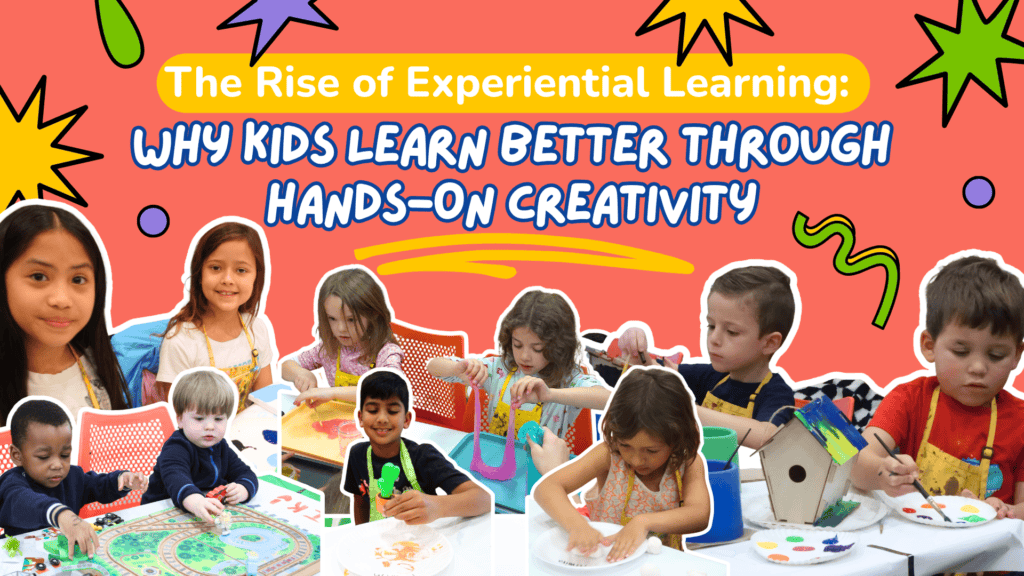
Education is evolving. Parents and educators are beginning to recognize that traditional, lecture-based learning is no longer enough to fully engage today’s children. Instead, a new approach is gaining momentum-experiential learning, where kids learn by doing rather than just listening.
At its core, experiential learning focuses on hands-on creativity, exploration, and real-world application. And the results are clear: children not only enjoy the process more, they also retain information better, build stronger skills, and develop confidence faster.
What Is Experiential Learning?
Experiential learning is a method where children actively participate in activities that require them to think, create, experiment, and solve problems.
Instead of being told how something works, they discover it themselves.
Examples include:
- Mixing ingredients to understand basic chemistry
- Painting and crafting to explore artistic expression
- Building projects that develop logic and spatial awareness
- Engaging in themed activities that combine storytelling with creation
This approach transforms learning into something interactive and memorable, rather than passive and forgettable.
Why Hands-On Creativity Works Better
1. It Engages Multiple Senses
When kids use their hands, eyes, and imagination at the same time, learning becomes more immersive. This multi-sensory experience strengthens memory and understanding.
2. It Encourages Problem-Solving
Hands-on activities naturally present challenges. Whether it is fixing a structure, adjusting a design, or experimenting with materials, kids learn how to think critically and adapt.
3. It Builds Confidence
Creating something from start to finish gives children a sense of accomplishment. That confidence carries over into other areas of life, including school and social interactions.
4. It Supports Different Learning Styles
Not all children learn the same way. Experiential learning allows visual, kinesthetic, and creative learners to thrive in ways traditional classrooms may not support.
5. It Makes Learning Enjoyable
When learning feels like play, children stay engaged longer. This leads to a deeper understanding without the resistance often seen in more rigid environments.
Beyond Academics: Real-World Skill Development
Experiential learning is not just about knowledge-it is about developing life skills.
Through creative, hands-on activities, children naturally build:
- Communication skills
- Collaboration and teamwork
- Creativity and innovation
- Emotional expression
- Independence and initiative
These are the same skills that will matter most in the future, especially in a world that increasingly values adaptability and creativity.
Why Parents Are Choosing Experiential Learning Spaces
More parents are now seeking environments outside of traditional schools where their children can:
- Explore freely
- Learn through creativity
- Develop confidence in a low-pressure setting
This has led to the rise of creative studios and experiential learning centers, where art, science, and play come together in a structured but enjoyable way.
One example of this new wave of learning spaces is Creatif Art & STEM Studio, which focuses on combining creativity, hands-on learning, and real-world skill development in a fun and engaging environment.
Creatif Art & STEM Studio offers a variety of experiences designed around experiential learning, including:
- DIY / Walk-In Canvas Painting
Kids can freely express themselves through painting, choosing their own designs, and creating artwork at their own pace. - Painting Workshops & Art Classes
Structured sessions help children build foundational skills in drawing, painting, and design while still keeping the experience fun and interactive. These classes are ideal for developing both technique and confidence over time. - Themed Summer Camps
A wide range of camps cater to different interests, such as:- Slime Camp (sensory play and basic science)
- Art Camp (painting, mixed media, and crafts)
- Science Camp (hands-on experiments and discovery)
- Clay Camp (sculpting and tactile creativity)
- AI and Tech Camps (introducing innovation and technology)
- Electronics Camp (building and problem-solving with circuits)
- Kawaii Art Camp (cute illustration styles and design)
- Creative Birthday Parties
Instead of traditional parties, kids experience interactive celebrations where they create and explore. Popular themes include:- Slime Party – colorful, stretchy, sensory fun
- Ceramic Party – painting pottery, wood, and creative objects
- Canvas Party – guided painting sessions with instructor support
- Brick Party – LEGO® challenges and building activities
- Clay Party – hands-on sculpting and creative expression
Each party is designed to be both fun and meaningful, allowing kids to take home something they made themselves.
Experiential learning is not just a trend-it is a shift in how children grow, think, and engage with the world.
By prioritizing hands-on creativity and active participation, children develop not only knowledge, but also the confidence and skills they need for the future.
Spaces that embrace this approach, like Creatif, are helping redefine what learning can look like – making it more meaningful, more engaging, and far more memorable. Visit www.creatif.com to learn more.